
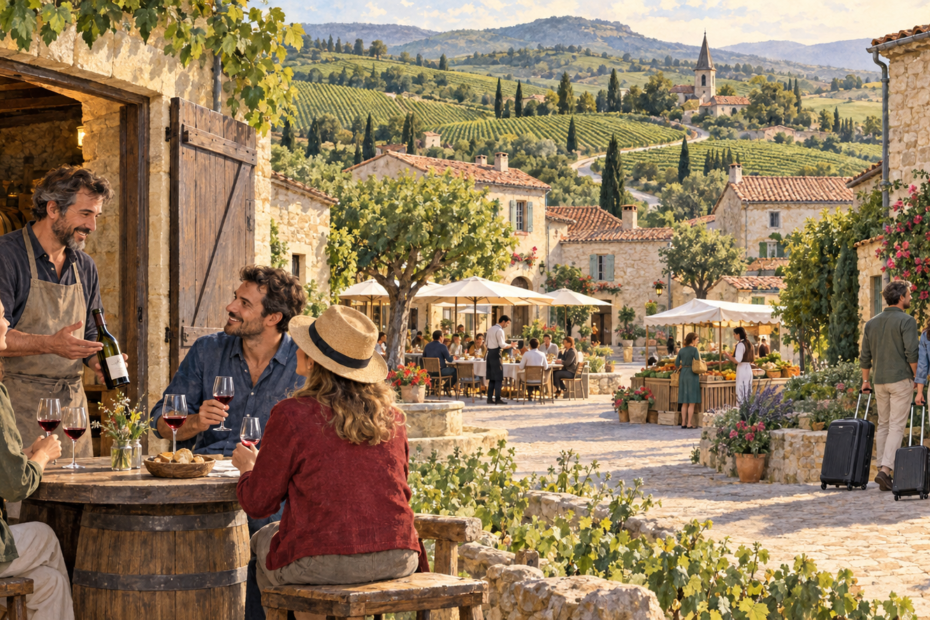
A geographical indication protects a product. But it does something else, something rarely measured: it permanently associates a reputation with a place. For a medium-sized town or a rural district, it is an asset that enhances the area’s appeal and cannot be relocated elsewhere.
A Name That Cannot Be Taken Elsewhere
A company can move. A brand can be sold, transferred or manufactured elsewhere. A geographical indication cannot.
The product specification for a geographical indication defines a geographical area as well as a production method. Comté can only be made in the Jura Mountains, Champagne only within its designated area, and Longjing tea only in the area around West Lake in Hangzhou. No expertise, investment or relocation can circumvent this constraint.
It is a form of scarcity guaranteed by law. And for a region, it represents a rare kind of asset: something that belongs to it and cannot be taken away.
The Figures Behind Food and Wine Tourism
French wine tourism provides the most thoroughly documented example.
According to Atout France, twelve million wine tourists visited French vineyards in 2023, including 6.6 million French visitors and 5.4 million international visitors. Visitor numbers increased by 20% between 2016 and 2023, with international visitor numbers growing by 29% — nearly twice the rate of growth among French visitors.
More than ten thousand wineries and wine estates are open to visitors, spread across seventeen major wine-producing regions.
Annual spending reaches €5.4 billion: €1.8 billion spent directly on wine tourism activities — tours, tastings and purchases — and €3.6 billion in additional spending on accommodation, dining, transport and cultural activities.
A study conducted by Deloitte for Vin & Société found that, when the knock-on effects on the hospitality and restaurant sectors are taken into account, total economic activity approaches €7 billion, and the sector supports nearly 31,000 full-time equivalent jobs.
Average spending stands at €72 per visitor per visit.
What These Figures Really Tell Us
Three characteristics of this type of tourism deserve the attention of local elected officials.
It is geographically dispersed. Wine-producing regions are not necessarily the traditional major tourist destinations. Nouvelle-Aquitaine welcomes 2.5 million visitors, Occitanie and Provence-Alpes-Côte d’Azur 2.3 million, Grand Est 2 million, and Bourgogne-Franche-Comté 1 million. These visitor flows benefit areas that are often far removed from major urban centres.
It extends across the year. The season runs from May to October, well beyond the summer peak. For an area whose hospitality businesses depend on just six weeks of activity a year, this represents a substantial rebalancing.
Visitors spend money locally. Two-thirds of expenditure goes towards accommodation, dining and cultural activities — benefiting local businesses rather than the wine industry alone.
The Impact on the Product Itself
A geographical indication also has direct economic value, and this has been measured.
A European Commission study published as early as 2013 found that products benefiting from a geographical indication sold for an average of twice the price of comparable products without such protection.
This price premium does more than reward the producer. It helps sustain agricultural activity in areas where it might otherwise become marginal, preserving landscapes, keeping land maintained and supporting local populations.
A region that loses its geographical indication loses far more than a label.
What a Tourist Office Can Do
The gap is a familiar one: the designation exists, its reputation is established, yet the region fails to leverage it as a tourism asset.
Several practical measures can make a difference.
Connect the product with the place. Visitors who recognise the name do not always know where the designated area is or what they can see there. A map is the first tool to provide.
Make visitor-friendly producers visible. Not all producers welcome visitors, and those who do are not always easy to find.
Connect the designation with the wider tourism offer. Restaurants serving the product, nearby accommodation, events, markets and museums all play a role. This network of attractions is what turns a visit into a stay.
Think about international visitors. Half of all wine tourists come from abroad, and their numbers are growing faster than those of French visitors. Content available only in French effectively addresses only half the audience.
The International Dimension
This is where the issue takes on a much broader significance.
Since 1 March 2021, an agreement between the European Union and China has provided reciprocal protection for geographical indications from both sides: one hundred European names in China and one hundred Chinese names in the European Union, followed by a second phase covering a further 175 names from each side.
For a European region, this means its geographical indication is now a recognised and protected name in the world’s largest consumer market. The same applies, in reverse, to Chinese regions.
But legal protection does not automatically create visibility. A protected name that no visitor knows remains an unfamiliar name, and no existing public scheme currently bridges this gap.
This is what Marco Polo International is working to build: a platform where designated regions in Europe and China can discover one another, in their own languages, showcasing what they have to offer and what visitors can experience there.
A Simple Question for Local Authorities
Your region is home to one or more protected geographical indications. The name is recognised, it is protected by law, and it cannot be relocated elsewhere.
Where can a visitor — French, European or Chinese — discover what that name represents, where the designated area is located, and what there is to see and do there?
If the answer is nowhere, there is an opportunity to build something.
Marco Polo International is a French non-profit association established under the French law of 1901. Founded in Paris in 1989, it is dedicated to developing cultural exchanges between France and China.