
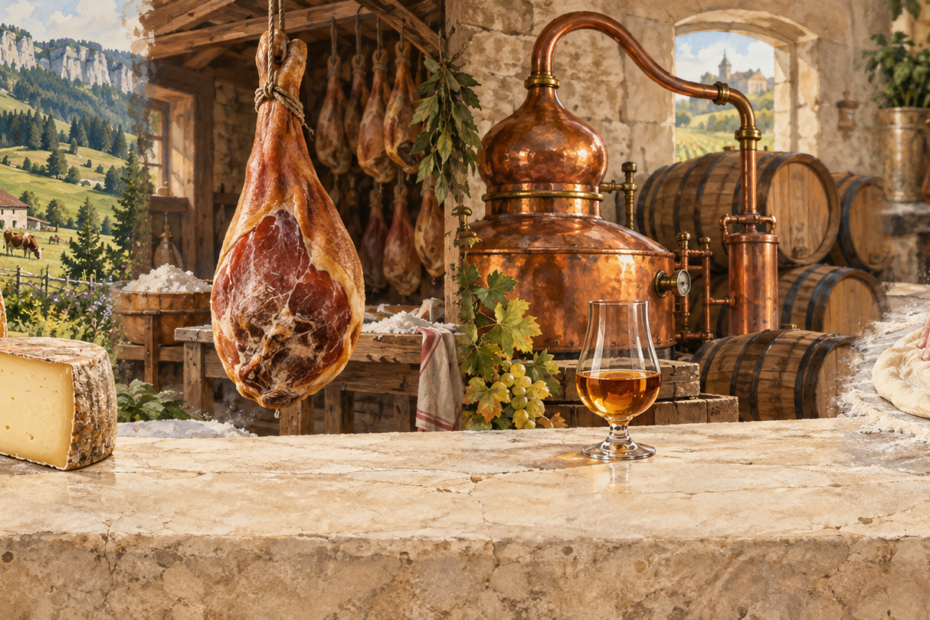
Four acronyms, four different approaches. Comté is a PDO, Bayonne ham a PGI, Cognac a geographical indication, and Mozzarella a traditional speciality guaranteed. These distinctions are not mere administrative technicalities: they determine who may use a name, and where.
Two Questions, Not One
Behind these acronyms lie two distinct questions that are often confused.
Where does the product come from? This is the logic behind geographical indications. The name identifies a place and is reserved for products that genuinely originate there.
How is it made? This is the logic behind traditional specialities. The name identifies a recipe or a production method, regardless of where it is used.
The first three designations address the first question. The fourth addresses the second, which is what makes it fundamentally different.
PDO: Everything Takes Place There
Protected Designation of Origin (PDO) is the most demanding designation.
Every stage of production must take place within the defined geographical area: the raw material is produced there, the product is processed there, and it is prepared there. The milk used for Comté comes from the Jura Mountains, where it is transformed into cheese and then matured.
There is an additional requirement whose significance is often underestimated: it must be demonstrated that the product’s quality is attributable to its geographical environment — its soil, climate and local know-how. This link to the place of origin is the legal substance of the designation. Without it, there is no PDO, only a regional recipe.
This is why a PDO cannot be relocated. A cheese made elsewhere using the same process is not Comté: it lacks the very qualities that make Comté what it is.
PGI: At Least One Stage Takes Place There
Protected Geographical Indication (PGI) follows the same logic, but with less stringent requirements.
Only one of the stages — production, processing or preparation — must take place within the defined geographical area. Bayonne ham can be made from pigs raised outside south-western France, provided that the salting and drying take place within the designated area.
The link to the geographical area must still exist, but it may be based on reputation or know-how rather than on the origin of the raw materials.
This flexibility explains why PGIs are more widespread and why they are suitable for supply chains whose sourcing extends beyond the boundaries of the designated area.
Spirit Drinks: A Single Designation
Spirit drinks are not covered by the PDO or PGI schemes.
Instead, they fall under a single category: the geographical indication (GI). Cognac, Armagnac, Grappa, Brandy de Jerez and Scotch Whisky are all geographical indications, with no distinction based on different levels of protection.
This is a frequent source of confusion: the expression “PDO Cognac” is sometimes encountered, but it has no regulatory standing. This does not make the requirements any less stringent — Cognac must be made from grapes grown within its designated area, distilled in Charentais copper pot stills and aged locally.
TSG: The Recipe Without the Place
The Traditional Speciality Guaranteed (TSG) scheme is fundamentally different. It protects a traditional composition or method of production, without any geographical area being required.
Any producer, anywhere in the European Union, may use the name provided they comply with the product specification. Mozzarella, Pizza Napoletana, Jamón Serrano and Gueuze are examples of TSG products.
This is where a common misunderstanding arises. “Mozzarella” is a TSG and can be produced anywhere, provided the applicable requirements are met. “Mozzarella di Bufala Campana” is a PDO, reserved for production within the designated area of Campania. The first name protects a recipe; the second protects a geographical origin. These are not two levels of the same designation, but two distinct legal schemes.
What Does Not Qualify as an Origin Designation
Two other labels appear on food packaging but have nothing to do with geographical origin.
The Label Rouge is a French quality label certifying a level of quality superior to that of a standard product of the same type. It says nothing about where the product is produced.
Organic farming certifies a production method that complies with environmental standards. It does not, in itself, indicate geographical origin either.
A single product may carry several designations: poultry may be both Label Rouge and PGI-certified, while a cheese may hold both PDO and organic certification.
Product Specifications and Controls
Whatever the designation, everything rests on a single document: the product specification.
It describes the product, defines the geographical area where applicable, lists permitted and prohibited practices — including animal breeds or grape varieties, animal feed, maturation periods and processing techniques — and substantiates the link to the geographical area.
This is not simply a declaration made in good faith. Compliance is verified through periodic audits conducted by an independent certification body. Any producer who fails to meet the requirements loses the right to use the protected name.
In France, the National Institute of Origin and Quality (INAO) examines applications and oversees this system.
What Changed in 2024
The European regulatory framework was comprehensively overhauled by Regulation (EU) 2024/1143 of 11 April 2024, which has applied since 13 May of that year.
The regulation consolidates rules that had previously been spread across three separate regulatory frameworks — agricultural products, wines and spirit drinks — and also covers Traditional Specialities Guaranteed and optional quality terms such as “mountain product”.
It simplifies registration and amendment procedures, strengthens protection, particularly online, and introduces sustainability criteria into product specifications, in line with the European Union’s “Farm to Fork” strategy.
Its provisions on labelling have applied since 14 May 2026.
Why the Distinction Matters
For consumers, these acronyms tell them what they are buying: a product associated with a particular place, or a product made according to a particular recipe.
For producers, they determine whether a name may be used and under what conditions.
For a geographical area, they represent an asset. A designation permanently associates a reputation with a place, and that reputation cannot be relocated. It is a form of scarcity guaranteed by law.
And for anyone interested in international trade, these distinctions are crucial: a mutual protection agreement, such as the one between the European Union and China that entered into force in 2021, protects only those names recognised under the law as geographical indications.
Marco Polo International is a French non-profit association established under the French law of 1901. Founded in Paris in 1989, it is dedicated to developing cultural exchanges between France and China.