
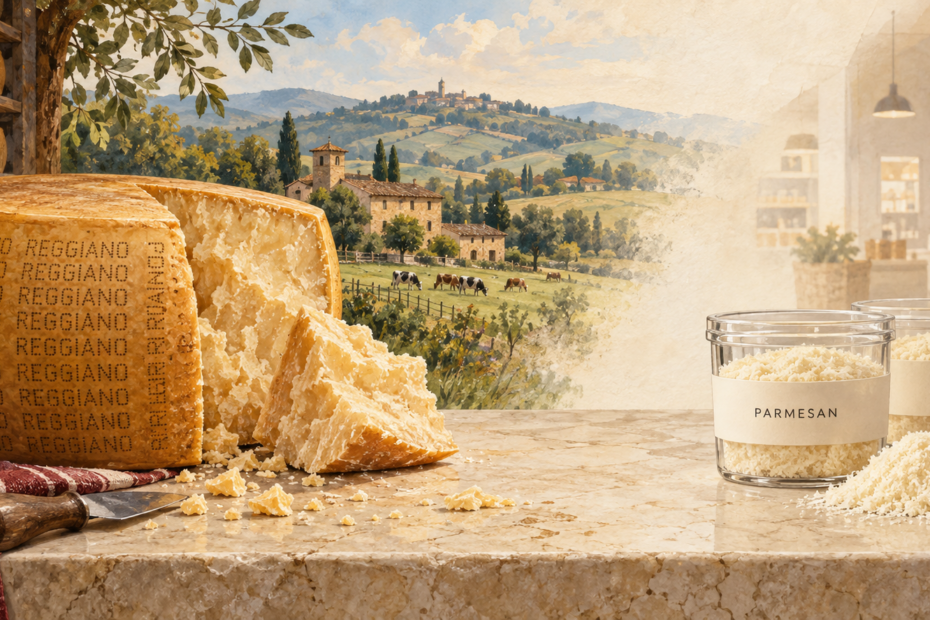
The same cheese has two names that do not enjoy the same legal status. One is a protected designation; the other has become, in much of the world, a generic term. The story behind this divergence offers the clearest possible lesson in what a geographical indication protects — and what happens when it does not.
What the Product Specification Requires
Parmigiano Reggiano has been registered as a Protected Designation of Origin (PDO) since 12 June 1996.
Its product specification is one of the strictest in Europe. The milk must come from cows raised within a precisely defined geographical area — the provinces of Parma, Reggio Emilia and Modena, as well as parts of the provinces of Bologna and Mantua. It is processed raw, without any additives. The cheese must be matured for at least twelve months, and often for twenty-four or thirty-six.
None of these requirements is optional. A cheese that fails to meet them is not Parmigiano Reggiano, even if it looks and tastes similar.
The Word “Parmesan”
“Parmesan” is the French — as well as the German and English — translation of Parmigiano. Etymologically, it means “from Parma”. The word originally referred to nothing other than a cheese from that region.
And yet it has come to mean something quite different: a hard cheese, grated and sold everywhere, often manufactured thousands of kilometres from Emilia.
This shift — from a geographical name to a product name — is known as genericisation. Once a designation has undergone this process, it cannot be reclaimed.
The Parmesan Dispute
The case came before the Court of Justice of the European Communities in 2004, following a referral by the European Commission.
Germany allowed cheeses that did not comply with the Italian product specification to be marketed under the name “Parmesan”. Its argument was straightforward: “Parmesan” had become a generic designation and could therefore no longer be protected through the registration of the name “Parmigiano Reggiano”.
The Commission, supported by Italy, argued that “Parmesan” was the exact translation of the protected designation and that the translation was entitled to the same protection as the original name.
The Court’s Grand Chamber delivered its judgment on 26 February 2008.
What the Court Decided
The Court’s reasoning is worth examining, because its implications extend far beyond this particular cheese.
First, the Court recalled that protection is not limited to the exact form in which a designation has been registered. Germany’s argument that a designation is protected only in the precise spelling under which it was registered did not hold.
The Court then identified phonetic and visual similarities between “Parmesan” and “Parmigiano Reggiano”, in a context where the products concerned were hard cheeses, grated or intended to be grated — and therefore similar in outward appearance.
It concluded that using the name “Parmesan” for a cheese that did not comply with the specification constituted an evocation of the protected designation. European law explicitly protects geographical indications against misuse, imitation and evocation.
The Court’s press release was unequivocal: only cheeses bearing the Protected Designation of Origin “Parmigiano Reggiano” may be sold under the name “Parmesan”.
The Paradox of the Judgment
And yet Germany was not found to be in breach of its obligations.
The Commission had accused Germany of failing to take action against abusive uses on its own initiative. The Court rejected this complaint, finding that the Commission had not established that the German legal system provided insufficient protection for the designation. The infringement action was therefore dismissed.
In other words, the principle was established, but enforcement was left to the rights holders — the Italian consortium, which must bring proceedings before national courts, case by case.
That is precisely what happened. A German court of appeal reaffirmed the principle in 2010, and legal proceedings have continued ever since, in Germany and elsewhere.
Legal protection is never automatic. Someone has to enforce it.
Outside Europe, the Name Is Lost
Within the European Union, “Parmesan” is protected. Elsewhere, the situation is often the opposite.
In the United States in particular, the word is treated as a generic term for a category of cheese. Any manufacturer can use it, and many do. Consumers who buy “Parmesan” are not necessarily buying an Italian product, nor do they necessarily expect to.
The name has lost its geographical meaning. It no longer identifies a place, only a texture and a use.
This is the fate that awaits any designation that is not adequately defended, and the loss may be irreversible: once a name has become generic in the minds of the public in a given country, no court can restore its original meaning.
The Lessons
Three lessons emerge from this case.
A name is lost through use, not by decree. No one ever decided that “Parmesan” should become generic. It became generic because its use was allowed to continue for a long time without challenge.
Protection extends beyond the exact name. Translations, transliterations and evocations: this is what distinguishes a geographical indication from an ordinary trademark, and it is the central lesson of the 2008 judgment.
Protecting a name means defending it. The law creates the opportunity; the body responsible for managing the designation must act on it. A designation without an active consortium is a designation living on borrowed time.
Why This Matters for China
Parmigiano Reggiano is among the one hundred European geographical indications protected in China since the bilateral agreement entered into force on 1 March 2021.
That protection also extends to Chinese-language translations and transliterations. This is precisely the provision designed to prevent the same process from recurring in the Chinese market: a name gradually becoming detached from its geographical origin until it no longer identifies a particular place.
The agreement did more than open up a market. It closed a door — the one through which geographical designations are lost.
Marco Polo International is a French non-profit association established under the French law of 1901. Founded in Paris in 1989, it is dedicated to developing cultural exchanges between France and China.